Packing: The rehearsal

Packing1

Face it — I’m a bit of a packing snob. Fifteen years of bicycle touring for three weeks at a time with only panniers and a small front tour pack taught me some valuable lessons.

I learned to choose a color palette (usually everything goes with black and white and gray — just throw in a little red to mix and match is easier, plus shoes can then be limited), realize you CAN wash things, even if it’s in the hotel bathroom or the campground sink with a little shampoo, and sometimes tell yourself, “I’ll never see these people again.”

A USA Today article “10 tips every packer should know” made me pretty happy. I basically follow all of this advice, from rolling items to take up less space and avoid wrinkles to wearing AND packing in layers.  According to Caroline Costello, SmarterTravel.com,  “TSA says pack items in layers (shoes one layer, clothes one layer, electronics one layer, etc.) so the security agent screening your bag can get a clear picture of what’s inside.” That way you get through the line faster.

But packing for Prague has its own set of challenges. First, it’s for Aug. 26 – Oct. 26, a sizable range of weather — from highs of 90, predicted two days after I arrive, to an average low of 36 the day I leave. That means going the compression bag route with a couple of coats and a small pile of sweaters.

Then, too, I’ll need teaching clothes, perhaps “dress-up” clothes, maybe something to wear if I go with a friend who has works on an acreage on weekends. Of course there’s also just daily clothes.

I have been auditioning my shoes all summer. Which are more comfortable? When I wear them all day, walking around, which didn’t give me blisters? Which could look slightly dressy or still go with jeans? Clothes, too, have faced the same scrutiny. What washes up without ironing, and what goes with lots of other items? Most important, what will be cool enough in late August and layer-able in the end of October.

I also THOUGHT I should be taking toiletries to last two months so I’d have brands I like, but I rethought that when the bag with shampoo, rinse, contact solution, shower gel and body lotion weight 8.5 lbs. I think I’ll be hitting the drug store and not worrying if I don’t smell like Bath & Body Works Sea Island Cotton.

The bedroom is currently a staging area with piles here and there. I know I won’t be able to bring everything I’ve pulled out of drawers and closets, but that’s OK. I tend to use the “optometrist” approach most of the time for my packing. Three different tops that go with one pair of pants — they don’t all fit in the suitcase? Okay, hold them up one at a time — are the pants better with top 1 or 2? Better with 2 or 3? Already one rain jacket was voted out of the suitcase — heavier than the other one and not as loose so more layers wouldn’t fit under it when the days get cooler. It stays home. By Monday, I’ll have a large pile of others that will stay with it. Time will tell if I chose the right things.

Candace in Prague 2.0

Screen Shot 2015-08-18 at 11.18.54 AM When the syllabus arrived in my email with the Anglo-American University logo and my name as an instructor at the top, I finally realized it was true… I’m going to be teaching college students in Prague this fall.

Thus my CandaceInPrague.com blog is back.

Of course this didn’t happen overnight. To get a sabbatical – technically a Professional Improvement Leave – requires applying the previous fall. As 6-12.101 of Kent State’s Policy Register says, “Full-timed tenured faculty … can apply in their seventh year….” Yadda yadda yadda.

And it’s not just a vacation. This must be related to the faculty member’s “professional growth and development” and “benefit both the individual and the university.” Mine will surely do all that and more.

So, next Tuesday, Aug. 25, I’ll depart for the Czech Republic with a larger suitcase than I’ve ever used and an AirBnB apartment I’ve never seen waiting for me. I plan to teach “Media & Shaping Public Opinion” to 15 BA and 3 MA students, though there may be more, and we meet Wednesday nights from 6:30 – 9:15 p.m. I’ll teach until fall break Oct. 26 and a regular lecturer I met there in 2013, my co-instructor, will take over for the rest of the semester.

I have a desk and work space and will be able to coach some Reporting 1 students. I also plan to conduct research about how those students decided on their course of study, similar to something I did last spring at Kent State. If we want the best and the brightest in media, we have to know how to attract them.

And I expect to walk a lot and see all the things I’ve missed on previous stays in this gorgeous City of 100 Spires. When I first bicycled into Prague in 1990, not that long after the Soviets left, I knew I would be back more than once. This will be my fifth and longest stay. Let’s see what it has in store for me. Whatever it is, I’ll write about it here. Please come along on the journey.

Day 15: When things go wrong

Waiting for their turn at the service desk for rebooked flights and hotel rooms, the #kentinprague group has a range of emotions.

Waiting for their turn at the service desk for rebooked flights and hotel rooms, the #kentinprague group has a range of emotions.

It might have been the student who forgot to wear her lucky necklace or the prof who told her husband, “I’ll see you Sunday night if things don’t get messed up.”

Or it could have really been some mechanical problem with Brussels Airlines’ 330 Airbus.

Whatever it was, we learned just as we were heading for the plane in Prague that our overseas flight was cancelled. Instead of flying to Dulles at 4:45, we were standing at the service desk, working out four different itineraries to get 12 of us home a day late.

We’d had a good plan, too, to beat that loud-mouthed American in the turquoise Polo shirt and everyone else to get the best available seats. But the Brussels Air agent corralled all the Dulles-bound passengers as we exited the plane and kept Katy and me from our planned dash to the front of the line.

Now we were split into four groups: two are going Frankfurt to Newark to Cleveland, two Zurich to Chicago to Cleveland, four Montreal to Newark to Cleveland and four Dulles to Cleveland (that one sounds preferable, but doesn’t leave until 4:45 and arrives at 11:30 p.m. while they others are scheduled to touch down closer to 8 p.m.).

Reactions? A range from mild annoyance, to tangible stress to barely contained glee from the group adding Montreal to its travel plans. The wait to retrieve luggage was long, but who wanted to trust what would happen to suitcases overnight in an airport? Even if they were mostly filled with dirty clothes, they were OUR dirty clothes, and some even had toothpaste and make-up and comfy jammies.

Once we had rooms in the Sheraton right across the street, once we had laughed our way through a marginal but free buffet dinner (How many ways can they serve rice?) and settled in to a decent WiFi signal and television that included “Meet the Press” (or local news if for those testing their French class vocabulary), it isn’t too bad.

Now….watch for the tweets tomorrow: #kentinprague …  in Montreal, #kentinprague …in Zurich and so on. We’ll continue to be able to say about international travel “Whatever” as long as we sleep in our own beds tomorrow night.

Day 13: The wind-down begins

LundborgIt’s Friday. Our flight to Brussels, then Washington-Dulles and finally Cleveland begins at 12:10 p.m. Sunday, or, actually, when the van picks us up outside Rezidence Lundborg at 9:15.

The wind-down began today.

That’s the time right before you leave an extended stay when you don’t really want to go home — I still haven’t seen the Jewish Quarter, and I just found a little park right under the bridge away from the tourist throngs — but you also know you need to get everything together so the going is smooth. And you really DO want to see your family — and your pets.

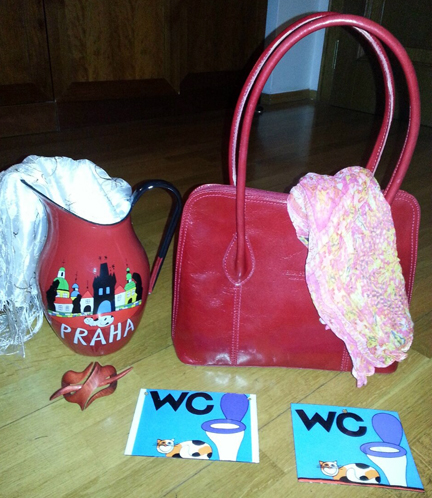
Kirstie found some things to bring home, most of them red, except for the WC sign, a topic of a KentInPrague.com blog she wrote.  (photo by Kirstie Ratzer-Farley)

Kirstie found some things to bring home, most of them red, except for the WC sign, a topic of a KentInPrague.com blog she wrote. (photo by Kirstie Ratzer-Farley)

Actually, the wind-down probably started earlier this week when Nicolle bought a scale. The number and variety of souvenirs the group will bring home is impressive. Mary’s large fluffy, pink llama is probably the most unique, though it does stuff down nicely into the one almost-empty suitcase she brought just for such a situation. Nicolle blogged about the souvenir topic last weekend, so it’s clear she will need to pack carefully.

I just had three takers for my two extra compression bags within the first minute of offering them on our Viber group chat.

Another telling sign of the wind-down was Kaitlynn, guiltily counting out coins to use for much of her dinner bill, just so that didn’t become a currency exchange dilemma.

I’ve spread out my clothes for tomorrow and planned to spots for what I’m wearing now.

We said good-bye to two valuable program connections: Alan Kraustengl, partner Anglo American University’s president, and Iva Skochova, assistant dean of the School of Journalism, but more important, our go-to person for journalism contacts and tips on everything from the Metro to the Czech personality.

Tomorrow we’ll fit in all we can: Some plan to head to Kutná Hora, where, according to estimates, bones of approximately 40,000 people were used to decorate the chapel. Others want to see the inside of St. Vitus Cathedral, which we’ve photographed at dawn, before it’s open, and at 10:30, after it closes, but our only daytime visit was with throngs of other tourists, and the line was too long.

The wind-down is full of one-last-times. We’ll end with a dinner on a boat in the Vlatava River and watch one last time the swans gliding by, and the sun setting behind the castle. We’ll walk home over the cobblestones and finish stuffing all we can into our suitcases — and all the memories we can into our minds. And I don’t think a single one of us will doubt that we’ll be back in Prague again someday.

Anna'sBridgePic

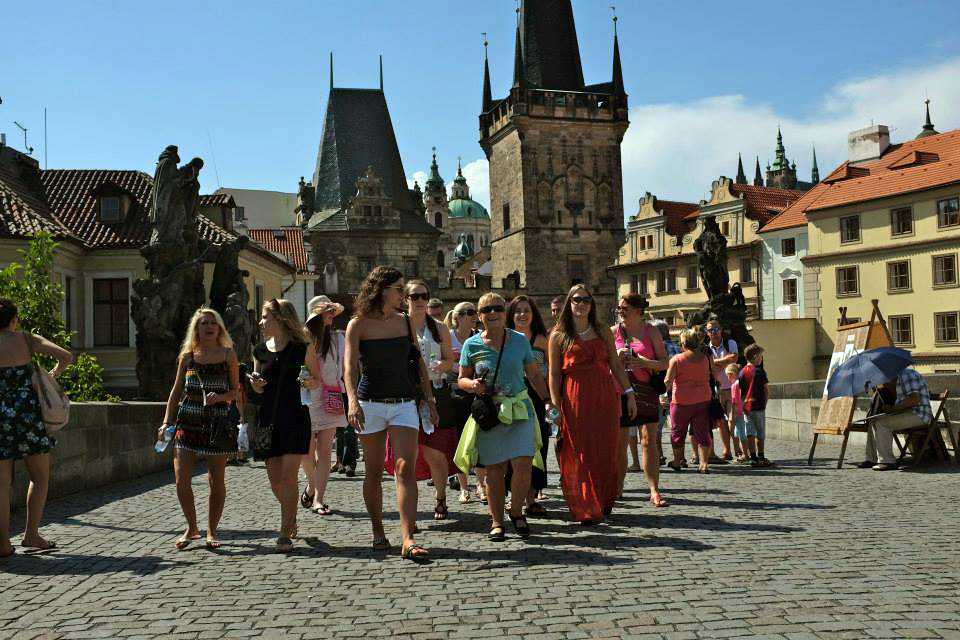
We were a curious, excited, jet-lagged bunch, wound up to begin this adventure as we strode across Charles Bridge with our leader and protector, Bibiana Hakosova Aug. 4. (photo by Anna Hoffman)

Day 11: Viber is our lifeline

IceCreamLuggage checked. Passports in hand. Backpacks hoisted in place. After the security lines at Hopkins Airport 12 days ago, we had a half hour at the gate before boarding. Three went for pizza, two headed to the bathrooms and one more wandered off somewhere. How would we ever stay connected in a foreign country without our U.S. phones and texts?

But then I didn’t know about the joys of Viber. (Disclaimer: I swear I wasn’t paid by Viber Media or any of its subsidiaries for what I’m about to print.)

As its website says, “Everyone in the world can connect. Freely.” It allows for free text messages, photo messages and video messages with other Viber users on iPhone®, Android™, Windows Phone, Blackberry®, Windows®, Mac, Symbian, Nokia S40 and Bada devices over 3G/4G or WiFi connections.

Viber Media, which launched the app, was founded in 2010 and claims more than 200 million users in more than 193 countries.

To us, this meant almost constant, free contact, as long as our phones had wifi access, which we had in the hotel, the university classroom, most restaurants, the military university at Vyškov– almost anywhere.

For individual conversations,  Erica asked me if I could log onto the WordPress site and give her feedback on her blog, Anna told me when her interview was and Kaitlynn called for a little first aid. (My patient is doing well.)

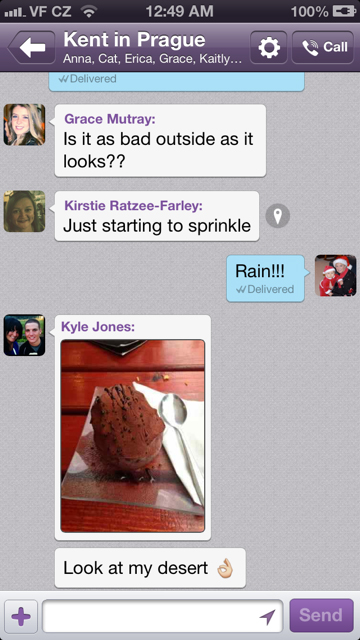
With a group set-up, we announced a change in plans to head to the metro, shared a reminder about the need for passports at Radio Free Europe, and put out a call for a photo needed for a blog. I posted the weather forecast as everyone was ready to hurry out the door (wear layers), and Nicolle and Mary announced plans for a gelato run at 9.

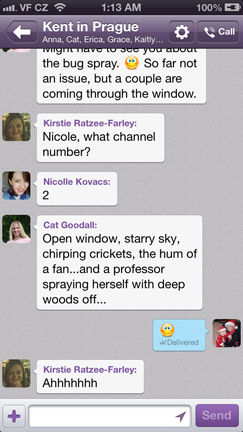
DeepWoodsPerhaps the most intense need was the night at Vyškov. We trudged down the long hall, and each of us unlocked a plain white door. We each walked into a sauna, in reality a narrow dormitory room with serviceable bed, desk and chairs, but with no air conditioning to combat the 97-degree heat. Each had a fan and windows that opened, but, without screens, we soon were swatting a host of moths and other insects.

It was uncomfortable, a little scary (we weren’t sure what the next day had in store), and more than a little isolated. Then Viber came alive. From 9:30 until almost 11:30, the jokes flew, the ding of each new post like a welcome voice from somewhere not TOO far away until one by one, everyone fell asleep.

Other similar services exist, but, for now, Viber has been our answer to staying connected, whether it has been for to meet up for dinner, plan logistics or pass a somewhat lonely evening in the company of friends.

Goodnight

Day 10: Vegetarian meets the meat-eaters

Having been to the Czech Republic before, I had no illusions about the cuisine. “It mostly consists of pork or beef meat with sauce and a side dish, the most common and liked being dumplings,” says Prague.net. Nothing is much further from my favorite foods than that! (I eat nothing with feet and believe gravy is an alien object.)

Svičková was an instant hit and a repeat meal for Cat Goodall. (photo by Nicolle Kovacs)

Svičková was an instant hit and a repeat meal for roommate Cat Goodall. Although I did take small taste of the gravy, that wasn’t my kind of food . (photo by Nicolle Kovacs)

But if I was going to nag my students to soak up the local culture and not head to McDonald’s (sadly, about a 5-minute walk, even more sadly, some did it daily), I needed to find a way to follow my own advice without drowning in a puddle of guláš (“goulash” — a Hungarian dish the Czechs have modified).

When one of the first menus had “Fried Ear of Central Bohemian Fattened Pig served on Lukewarm Potato-and-Leek Salad with Mayonnaise, Cured Cheese and Lightly Boiled Egg,” I thought I was in trouble.

Luckily, the lovely restaurant just steps from Anglo American University where we are working, had plenty more to offer me. Konírna served me salmon tartar with marinated fennel, crème frâiche and roasted baguette for my first lunch in Prague. Authentic? Yes, the menu says it “comes from the well-known fish ponds in the Třeboň region.”

In fact, salmon is a frequent easy lunch or dinner choice. Usually broiled, it’s served with everything from that same lukewarm potato-and-leek salad (not as bad as it sounds) to pretty standard fries to vegetable garnishes, depending on the restaurant.

Other restaurants and even carry-out stands allowed me to eat Czech and still stay away from meat and fried or breaded entres. Another standby has become caprese — as a traditional tomato and fresh mozzarella salad or, better yet, as a sandwich on a crusty whole grain baguette from the one-woman sandwich shop just around the corner.

Other good options have included thin-brothed though flavorful vegetable soup in a rye bread bowl and Greek salad (maybe not authentic-sounding but it appears on a wide range of menus). Grilled prawns and cuddlefish on a bed of lightly dressed field greens worked for me — though the octopus-looking tentacles on the fish weren’t popular with some of the party.

From cherry to "American cookie" to sometimes tiramisu, gelato choices for a 10 p.m. break works for meat-eaters and vegetarians alike. (photo by Kirstie Ratzer-Farley)

A gelato break (photo by Kirstie Ratzer-Farley)

In short, from grilled vegetables and cous-cous to the ever-available salmon, four-cheese pizza that includes brie and gorgonzola, and the hotel’s endless breakfast buffet of fruit, salad, cheese, yogurt, rolls and more, Prague offers vegetarians plenty of authentic options.

And then there’s always gelato at 10 p.m., which works for vegetarians and meat-eaters alike.

Day 9: So this is why they train

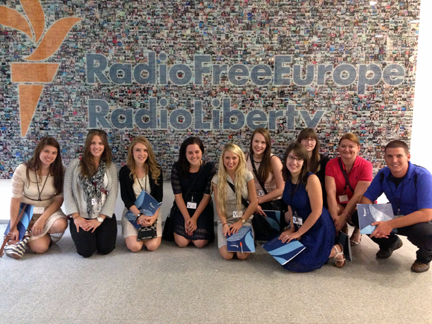
Security is tight at the RFE/RL building. Terrorists in countries the signals reach are not always happy with reporting.

Security is tight at the RFE/RL building. Terrorists in countries the signals reach are not always happy with reporting.

Akbar Ayazi, Radio Free Europe/Radio Liberty’s regional director who oversees Afghanistan and Pakistan, leaned his elbows on the long conference table and described a situation with a reporter in the field. “Cut him off. Make him go home. I don’t want him there,” he said at the time.

He looked at the wide eyes of the 12 Americans sitting around the table and added, “No report is worth your life.”

Suddenly the videos of training we saw on our trip to the military university in Vyškov last week came into focus. Reporting can be frightening, dangerous work, and anyone reporting in the 21 countries RFE/RL reaches is going to want any edge he or she can get. Fourteen days of physical discomfort and mental anguish might provide the skills and spark to make staying alive possible.

Not every journalist working with RFE is in a life-threatening situation. Daisy Sindelar shared some of her thoughts about being a senior correspondent in the the Prague Central Newsroom and a feature writer. She said being a mother has probably made a difference in how she sees some stories. She declined our tour leader Larisa Balanovskaya’s offer to get one story as an example of Daisy’s writing. “I’d rather not cry,” she said softly.

Glenn Kates, manager of digital initiatives for RFE/RL, said the “difference between knowing something is happening and seeing it happen” is huge. His example — a video showing Russian Parliamentary election fraud — is the kind of story the made a difference because people couldn’t ignore the situation then. “It changed things,” he said.

“We must be balanced, fair and comprehensive,” Ayazi said. “Some things need to be public,”Irina Lagunina, managing editor of the Russian Service said. The 500 who work in RFE/RL’s Prague headquarters and the other 1,000 around the world must believe this. Their examples and explanations gave the Kent State group a new view of journalists, one they hadn’t seen before.

Anna Hoffman, Leah Heiser, Grace Murray, Katy Coduto,  Erica Torre, Kaitlynn LeBeau, Nicolle Kovacs, Mary Betz, Kirstie Ratzer-Farley and Kyle Jones

Anna Hoffman, Leah Heiser, Grace Murray, Katy Coduto, Erica Torre, Kaitlynn LeBeau, Nicolle Kovacs, Mary Betz, Kirstie Ratzer-Farley and Kyle Jones

Day 8: How to make a teacher smile in any language

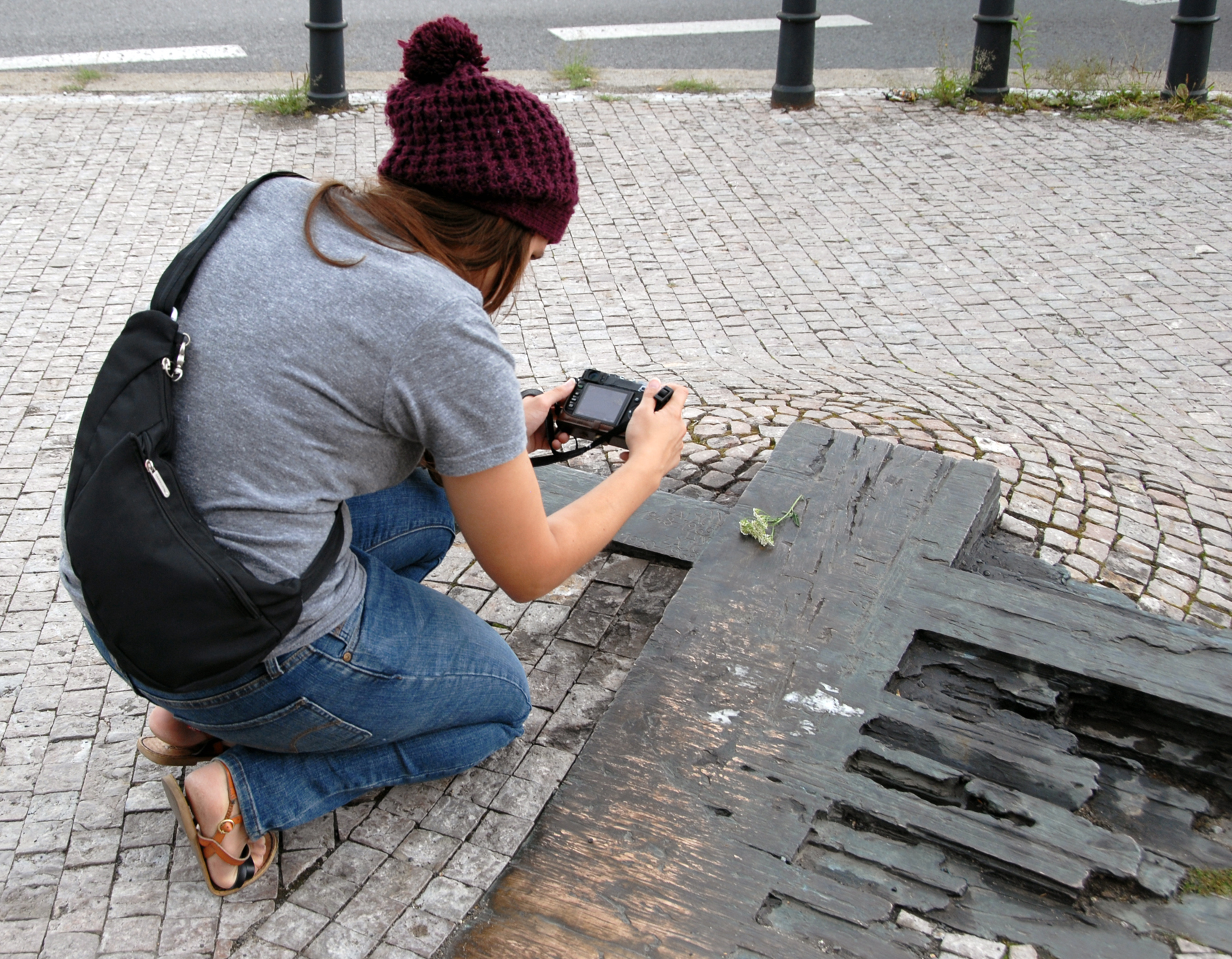
First stop on the Dissident Tour finds leader Anna Hoffman finding all the good angles to tell about the Memorial to the Victims of Communism.

First stop on the Dissident Tour finds leader Anna Hoffman finding all the good angles to tell about the Memorial to the Victims of Communism.

If a student were to ask how to make me happy, I’d say solve a problem on your own, use your creativity to go beyond what you have to do and show me you enjoyed what you learned.

Our 10 Kent State students in Prague for “Modern Media and Democracy” are doing just that:

  • Several with no techie background caught on to setting up WordPress galleries and learning not only HOW to add links to give their posts depth, but also WHY they should want to. After only a week, there’s no need for hand-holding as they have taken excellent photos for this very visual theme site and done all the work themselves.
  • The Communication Studies students, bless their hearts, have gone from humoring me when I suggested they tighten their blog writing until now they actually see how this new purpose and new audience means that my unfamiliar style really DOES work– and they can do it.
  • Those who are having a tough time getting sources are tirelessly following suggestions, networking and actually beginning to find people who will be able to answer their questions, allowing them to finish their final projects. (Try having media coverage of Romanies as your focus when this controversial minority generally speaks NEITHER English nor Czech!)
Hoffman takes more photos on the site where student Jan Palach lit himself on fire to draw attention to the plight of the Czechoslovak people

Hoffman takes more photos on the site where student Jan Palach lit himself on fire to draw attention to the plight of the Czechoslovak people

Today’s example of above and beyond is noteworthy, though. Anna Hoffman’s topic is the dissidents, the group that included Václav Havel, last president of Czechoslovakia and first president of the Czech Republic. To learn more and to be able to photograph the sites important to this group that prepared the text of Charter 77 and worked for the fall of Communism in 1989, Anna set up what we called “The Dissidents’ Tour.”

With her in the lead, armed with a Google Map she created, seven of us spent much of Sunday touring important sites like the Memorial to the Victims of Communism, the cafe where the dissidents met, even though their lives were at risk, the spot in Wenceslas Square where student Jan Palach set himself on fire and died for his cause in 1969. At each stop on her planned route, Anna told us all the background and why this was important.

I won’t explain or share my photos of all the sites — I wouldn’t want to potentially take away from her actual project. Clearly, I don’t have the knowledge she does about it. But, thanks to her, I know much more than I did when we left the hotel this morning, and I definitely smile each time I think of all she has gained and given to others with her assignment.